
British sustainable packaging company Frugalpac has today unveiled a high-speed new machine that dramatically increases the production of its paper Frugal Bottles, enabling drinks brands, fillers and packaging partners to scale beyond the limits of glass.
The launch comes as the UN’s World Meteorological Organization warned this week that the Earth’s climate is increasingly out of balance, with greenhouse gas emissions driving accelerating warming.[1]
The new Frugal Bottle Assembly Machine 2 (FBAM-2) is a scalable platform capable of producing 14 million paper bottles a year – more than five times the capacity of its predecessor, FBAM-1, which produces up to 2.5 million annually[2].
Designed for installation at bottling plants and packaging facilities worldwide, the FBAM-2 allows partners to manufacture Frugal Bottles at scale, closer to filling lines, reducing cost, carbon and supply chain risk. Its flexible multi-lane options allow for both smaller and significantly larger production volumes.
Frugalpac, a King’s Award-winning cleantech company based in Suffolk, launched the Frugal Bottle in 2020. Still the world’s first and only commercially available paper bottle for wines, spirits and edible oils. It is made from 100% recycled paperboard and has a carbon footprint up to 84% lower than a standard glass bottle.
Driving Costs Down
With the FBAM-2, the Frugal Bottle is now up to 30% lower cost than the current paper bottles, bringing it to price parity – or better – than a labelled glass bottle. As energy prices are increasing at pace, the Frugal Bottle is not just the sustainable choice but the smart economic one.
Scaling beyond glass
The launch of FBAM-2 marks a step change for the drinks industry, where demand for lower-carbon packaging is accelerating but production capacity has remained a bottleneck.
Until now, the rollout of paper bottles has been limited by manufacturing scale. FBAM-2 removes that constraint, enabling millions more bottles to be produced annually at a single site.
This opens the door for:
- Large-scale brand adoption
- Multi-market rollouts
- Integration into existing bottling operations
Industry under pressure
The launch comes as the global drinks sector faces mounting pressure from multiple directions.
Glass production requires furnaces operating at temperatures of around 1,500°C, often powered by fossil fuels, and supply chains have been hit in recent years by energy shocks, rising costs and material shortages.
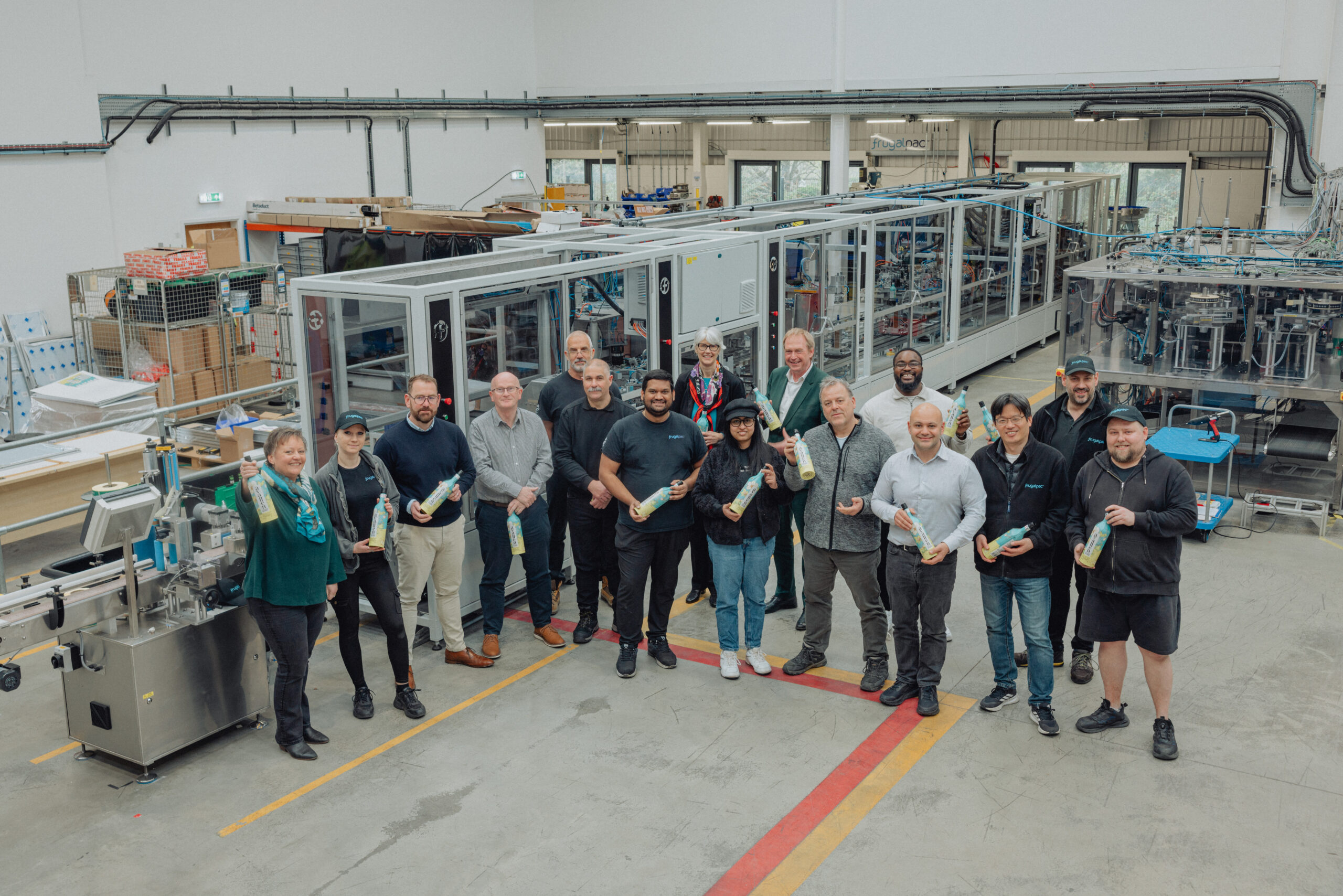
The Frugalpac team at its Ipswich HQ celebrate the launch of the FBAM-2
At the same time, new Extended Producer Responsibility (EPR) rules across the UK, Europe and other markets mean companies are increasingly charged for the environmental cost of their packaging, with heavier materials like glass among the most expensive.
Retailers are also turning their attention to packaging as a major source of emissions. Alcoholic drinks are now the largest contributor to supermarket packaging impact, accounting for roughly 33% of all environmental impacts in the grocery aisle, driven largely by glass bottles. (Source IGD)
The Stats: Glass vs. Paper
Frugalpac commissioned an independent Life Cycle Assessment (LCA) by Intertek in 2020, later updated in 2023. Key findings:
| Metric | Glass Bottle (750ml) | New Frugal Bottle (750ml) | % Reduction |
| Weight | 440g | 70g | 84% |
| Carbon footprint | 558g CO₂e | 92g CO₂e | 84% |
| Water footprint | 3.36 litres | 0.59 litre | 76% |
| Recycled content | 35% (glass average) | 100% paperboard | n/a |
Each Frugal Bottle saves 348g of CO₂e compared to a glass bottle. With 4 million bottles already produced, the cumulative savings are now over 1,392 tonnes of CO₂ – the equivalent of 3.5 million miles driven in a petrol car.
A Category Under Strain
Furthermore, a 2023 Shorr Packaging study revealed that 73% of consumers are willing to switch brands for more sustainable packaging. Younger cohorts Gen Z and Millennials are leading this shift, increasingly viewing heavy glass as a symbol of climate inertia rather than a mark of quality.
Packaging is becoming one of the most visible ways for brands to demonstrate climate action and lighter, recyclable formats such as paper are gaining trust and traction.
With full 360-degree printability, the Frugal Bottle gives brand owners a powerful canvas to engage a new generation of discerning consumers with products that mean something to this generation
The Future is Lighter
Since its 2020 debut, over 4 million Frugal Bottles have been produced. The format is already a retail reality, stocked by giants such as Sainsbury’s, Aldi, Whole Foods, Target, and 7-Eleven.
The company’s approach combines low-carbon materials with localised production, allowing bottles to be assembled closer to filling sites, reducing transport emissions, breakage and supply chain risk.
The FBAM-2 enables distributed manufacturing, allowing early-adopter partners like Monterey Wine Company (USA) and KinsBrae Packaging (Canada) to assemble bottles on-site. This eliminates packaging miles – the carbon cost of shipping empty glass bottles – and secures the supply chain against global glass shortages.
J.P. Grogan, Product Director at Frugalpac, said: “The FBAM-2 is the industrial rollout the mass market has been waiting for.
“We have engineered it for maximum uptime and modular flexibility, allowing it to handle everything from spirits and wine to oils and ready-to-drink (RTD) cocktails.
“The technology is ready; the era of heavy glass is over.”
Malcolm Waugh, CEO of Frugalpac, added: “For decades, glass has been the default for wine and spirits. But it’s heavy, energy-intensive and increasingly expensive to use and recycle.
“What’s changed is that packaging is no longer just a design choice, it’s a climate decision. Glass is no longer neutral.
“The FBAM-2 gives the industry a practical way to move faster; cutting carbon, reducing costs and producing bottles closer to where drinks are made and sold.
“The opportunity is clear. The technology is ready. The future of packaging is lighter and of a lower cost and the industry now has the tools to get there.”
ENDS
Notes to Editors
Download hi res images here
https://drive.google.com/drive/folders/1Rj0MRsSa3yoDcG57Kmv5s8Bcab2NpkCm?usp=sharing
For press enquiries: Sara Kendall sara@larkinpr.co.uk / 07814 024 266
FBAM-2 production capacity:
The FBAM-2 is a scalable, multi-lane platform with centralised controls.
- A single-lane configuration produces approximately 4.5 million bottles per year
- The standard three-lane configuration produces approximately 14 million bottles annually
- Additional lanes can be added to increase capacity further, with no fixed upper production limit
About Frugalpac
Frugalpac Limited is a British sustainable packaging company developing a range of innovative sustainable packaging products. It creates and supplies recycled paper-based products with the lowest carbon footprint that are easily recycled again.
In 2020, it launched the Frugal Bottle, the world’s first and only commercially available paper bottle for wines and spirits, with a carbon footprint 84% lower than a glass bottle.
All Frugalpac products are made from at least 90% recycled paper, are easily recyclable again and have the lowest carbon footprint compared with conventional and compostable packaging. They also create and sell the machines that make their paper products.
Frugalpac, which won SME of the Year at the UK Green Business Awards and a King’s Award for Enterprise, has secured £25m in funding.
About the Frugal Bottle
- It’s lighter. The Frugal Bottle weighs just 83g so it is up to five times lighter than a normal glass bottle, making it easier to carry and lighter to transport.
- It’s better for the environment. An independent Life Cycle Analysis by Intertek found the Frugal Bottle, which is made from recycled paperboard with no chemicals, has a carbon footprint up to six times (84%) lower than a glass bottle and more than a third less than a bottle made from 100% recycled plastic. The Frugal Bottle’s water footprint is also at least four times lower than glass.
- It’s easy to recycle again. Simply separate the plastic food-grade pouch from the paper bottle and put them in your respective recycling bins. The food grade pouch is certified recyclable and is a mono material polyethylene-based pouch.
- It uses less plastic than a plastic bottle. The Frugal Bottle uses up to 77% less plastic. Only 15g compared to a 64g bottle made from 100% recycled plastic.
- It stands out. As the Frugal Bottle is made from recycled paperboard, it allows for 360-degree branding across the bottle. No other wine or spirits bottle looks or feels like it, so it stands out on shelf and table.
- It’s better for wine producers. The Frugal Bottle can be produced in the heart of their bottling facility, offers complete freedom on design and print, is more cost effective to transport than glass bottles while reducing their carbon footprint further.
[1]World Meteorological Organization (WMO) State of the Global Climate 2025 – https://wmo.int/news/media-centre/earths-climate-swings-increasingly-out-of-balance
[2] 14m unit output when FBAM-2 is in its standard three lane configuration. See Notes to Editors for more information.